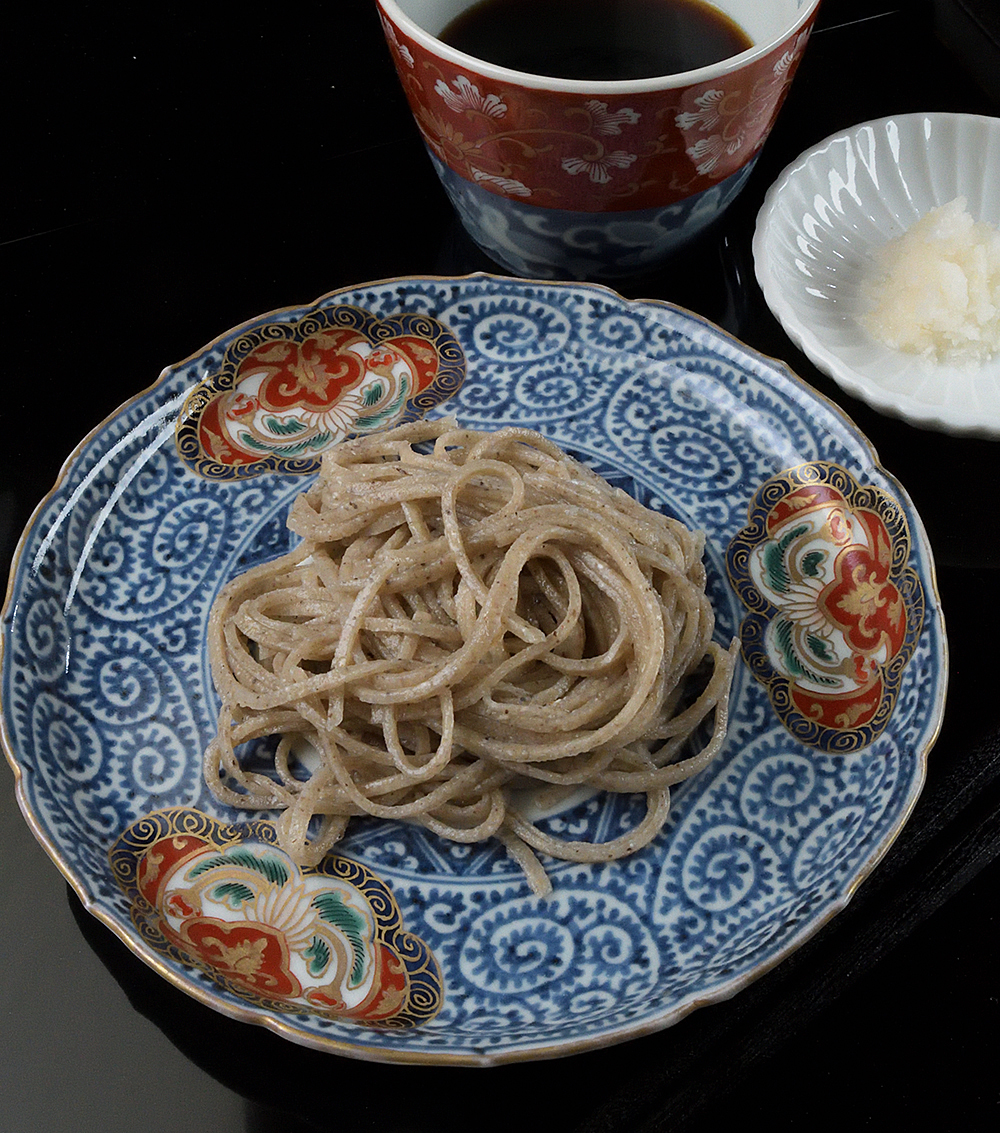
⬇︎ “Takokarakusa Juwari Soba,” created by Toranosuke Katayama. Soba presented as art, unveiled in August 2026.
Toranosuke Katayama
When it comes to soba, the most popular options are “ni-hachi soba” and “ju-wari soba.”
Which of these two is more delicious?
Also, what exactly is the difference between them?
We’ll give you a complete breakdown of the appeal of both ni-hachi soba and ju-wari soba.
First of all, “ni-hachi soba” refers to soba noodles made by mixing 80% buckwheat flour and 20% wheat flour.
The reason wheat flour is added dates back to the Edo period, when refrigeration technology was still underdeveloped. To prevent the buckwheat flour—which would deteriorate in the summer heat and become difficult to form into thin, continuous noodles—from falling apart, wheat flour was mixed in.
As you know, wheat flour contains gluten, and it was this gluten that allowed the noodles to be shaped into long, continuous strands.
Adding wheat flour makes the texture of the gluten more pronounced.
That’s why Ni-hachi soba has a smooth, slippery texture—much like udon or pasta—that slides effortlessly down the throat.
People who enjoy this texture often say things like, “It goes down smoothly,” or “Soba is meant to be eaten without chewing,” as if that were the very essence of soba.
However, adding wheat flour dilutes the inherent “aroma” and “flavor” of buckwheat, while simultaneously causing the “natural texture” of buckwheat noodles—as found in noodles made solely from buckwheat—to be lost.
In other words, it ceases to be “buckwheat noodles” and becomes “gluten (wheat flour) noodles” instead.
People who consider Ni-hachi soba delicious are those who enjoy this “smooth, slippery texture.”
In contrast, “ju-wari soba” is made entirely from 100% buckwheat flour. If high-quality buckwheat flour is used and the noodles are prepared correctly, you can experience the strong aroma and flavor of buckwheat, resulting in a truly delicious noodle.
Some people who prefer “ni-hachi soba” say, “Ju-wari soba has a crumbly texture and breaks easily, so it’s not tasty,” but that opinion is not accurate.
The final result of soba depends greatly on who made it and what ingredients were used. Juwari soba made by a skilled artisan has no dry, crumbly texture, goes down smoothly, and allows you to enjoy its strong flavor and aroma.
As with any dish, who made it is extremely important. Anyone who has actually eaten truly delicious 100% buckwheat soba would never voice the mistaken opinions expressed by the 20-80 soba enthusiasts mentioned earlier. In short, it is people who are unfamiliar with properly made 100% buckwheat soba who offer misguided criticism.
Soba is traditionally made from 100% buckwheat flour. That is what “soba” is.
And because soba contains no gluten, it breaks more easily than wheat flour noodles. That’s just the way it should be. Soba is meant to break, and it is soba precisely because it breaks.
The true delight of soba lies in the way it breaks. As the noodles snap cleanly in your mouth, the flavor and aroma of the buckwheat flour spread richly throughout your palate from the broken ends. This is the true delight of soba.
Many people who make 2:8 soba use three rolling pins and press down firmly on the dough. By applying this pressure,
they aim to eliminate the floppy softness inherent in gluten and create firm noodles.
The reason for making the noodles firm is to mimic the texture of 100% buckwheat soba.
Jūwari soba has a natural firmness inherent in the buckwheat flour itself, which strongly stimulates the mouth when eaten, allowing you to fully enjoy the authentic texture of buckwheat noodles.
That is why truly delicious jūwari soba has straight, right-angled edges where the noodles are cut with a knife; soba in this condition is highly regarded, with the saying, “Soba with sharp edges is delicious.”
Nihachi soba is made by using three rolling pins to press the dough firmly, but this method is actually
incorrect.
When the dough is pressed too hard, the flavor and aroma of the buckwheat become trapped inside the flattened noodles and cannot escape even after boiling. As a result, when you eat it, you only experience the smooth texture, and the flavor and aroma are lost. This is the weakness of Ni-hachi soba; in the Edo period, it was even called “da-soba” (bad soba).
To prevent the flavor of the buckwheat from being lost, it is necessary to use the method advocated by Toranosuke Katayama—“katakake, ippon-bō, maru-noshi”—which involves using only a single rolling pin.
This is the correct, traditional method for making Japanese soba.
If you’ve read this far, you probably already understand.
When comparing “ni-hachi” soba and “ju-wari” soba, the more delicious option is “properly made ju-wari soba.”
Whether it’s ju-wari soba or ni-hachi soba, soba made using the wrong technique is bound to taste bad.
“Who made the soba you’re eating?” If you want to enjoy delicious soba, please pay close attention to this point.
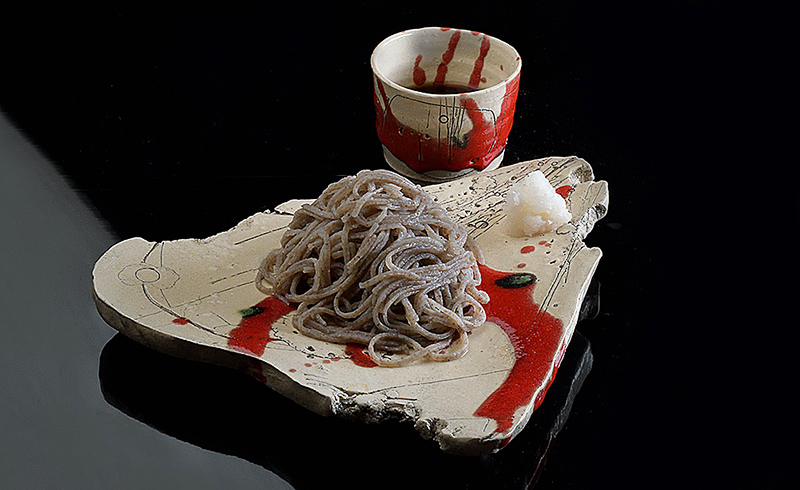
⬇︎“Van Gogh’s Ni-Hachi Soba,” unveiled by Toranosuke Katayama in 2022. It is a work of art featuring soba noodles and is considered “the greatest masterpiece of Ni-Hachi Soba.”
However, this does not mean that all soba containing wheat flour is unpalatable.
When made by someone who can fully control the properties of wheat flour and use it to bring out the flavor of the buckwheat flour, wheat flour can actually add a whole new dimension of flavor.
A prime example of this type of soba is “Van Gogh’s Ni-Hachi Soba,” which Toranosuke Katayama created as an artistic soba and unveiled in 2022. This soba has become extremely popular and is now hailed as “the masterpiece of ni-hachi soba.”
In any case, “who made the soba you’re eating” is the most important factor when seeking deliciousness.